
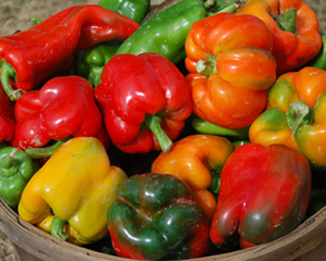
 A variety of colorful sweet peppers
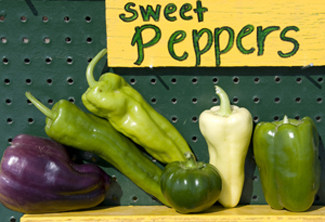 Sweet peppers at green-ripe stage
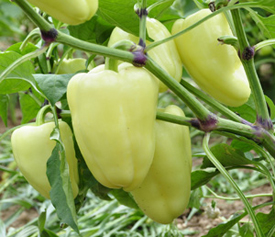 European stuffing pepper
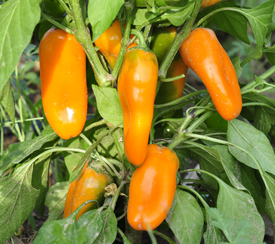 Yummy snack peppers
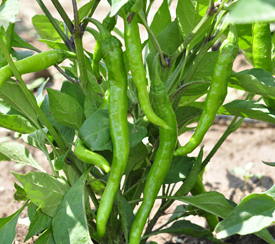 Small-fruited Specialty Sweet Peppers
Peppers are our favorite vegetable to grow. The fruit are brightly colored, lovely to look at, easy to pick and wonderful to eat. By sweet peppers we mean those types of peppers in which we cannot feel, taste, sense, or otherwise perceive the presence of capsaicin in the pepper fruit. (Capsaicin is the substance that makes peppers spicy or hot. Please see our Hot Peppers page for information about the Hot Peppers we raise.)
Bell Peppers, the short, blocky 3-6 lobed varieties popular for stuffed peppers in this country. Colors range from cream-white to yellow to green to purple ripening to yellow, orange and red.
Cubanelle and European Frying Peppers are popular in cuisine from south-eastern Europe and from the Caribbean basin. Cubanelles start yellow-green and ripen to orange. Italian Frying peppers are dark green ripening to red.
European Stuffing Peppers are short, conical, somewhat blocky, thin walled peppers that start yellow and ripen to orange.
Snack Peppers are increasingly common and well-known in this country. Snack Peppers can be washed and eaten whole. The variety we raise is green ripening to orange. Snack pepper flavor is best when the peppers are a bright orange. Try packing some in lunches.
Small-fruited Specialty Peppers are long, narrow (in diameter), thin-walled sweet peppers of Asian origin. They are glossy green at green-ripe stage and ripen to red.
The first few green-ripe bell and sweet banana peppers are usually ready to pick in very late July at The Tree Farm. Throughout August, the supply increases steadily. A few ripe fruit may appear by the end of August. All kinds of peppers at all stages of maturity are usually available by the second week in September. The pepper season ends when a hard frost kills the plants.
Select the stage of maturity you want. Most people use peppers at two stages of maturity, green-ripe or red-ripe. These are stages of maturity, not necessarily colors. Green-ripe peppers are full size for their cultivar, firm and shiny. They may be colored green, yellow or even purple. Green-ripe peppers have a pleasant, slightly pungent flavor. For example, the common green bell pepper one finds in grocery stores are green-ripe. Red ripe peppers have matured to their "ripe" color, which for the varieties raised at The Tree Farm may be yellow, orange or red. Red-ripe peppers are sweeter, often very sweet, and less pungent than green-ripe peppers.
Peppers are easy to pick. Sometimes it is necessary to look under the canopy to find them, but they are so big and colorful that they are hard to miss. To pick peppers, gently twist and pull until the pepper comes off the plant. Gently, because the pepper plants are quite brittle, can be broken easily and will continue to produce fruit if they remain intact.
Green-ripe and ripe peppers are great cut into strips for finger food. They are also excellent in salads and relish trays. Slices of pepper add a wonderful crunch and flavor to a sandwich or a taco filling. They dress up a table with their attractive colors. Peppers are an important ingredient in many kinds of cooked dishes, including stuffed peppers, casseroles, chili, stir fries, shish kebob, omelets and many others. Cubanelles are often fried in olive oil with garlic and served either warm or cold. Peppers usually enhance the flavor of any dish that includes tomatoes.
Peppers are easy to freeze. They do not require blanching. Many people simply seed and chop them before putting them into the freezer. Others cut them in halves, remove the seeds, and stack the halves for the freezer. Frozen peppers retain their flavor but not their texture. Chopped peppers can be frozen on a flat pan and then placed in containers only after they are frozen to prevent them from freezing together.
The Tree Farm
The Pick-your-own Pumpkins Place
www.thetreefarm.net
In Northwestern Dane County, Wisconsin, serving Madison and the surrounding area
8454 State Road 19
Cross Plains, WI 53528
608.798.2286
farm@thetreefarm.net

Updated May 07 2017

Copyright © 2004-2026 UPPER LLC dba The Tree Farm. All Rights Reserved.